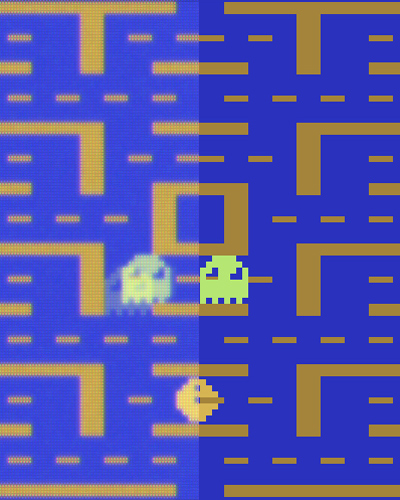
They are small games created for Atari VCS, each under 1K in size and created in less than one day's time. Please read my statement at bottom for a more detailed explanantion of my motivations.
I'll add to this page over time, as I create more of these. I have no preconception about how frequently that might be, but I hope to develop a collection of game poems over time, a videogame chapbook of sorts.
Notes: All of these games are winnable, but how to do so may not be immediately obvious. ♦ You'll need an emulator like Stella to play them. ♦ The game files are 2K because that is the minimum for an assembled VCS binary. I am only using half of that space for code and data (open the binaries up in a hex editor if this is bugging you).
Download Stately Hippo
View a larger screenshot
Joystick Right: move hippo right
Joystick Button: modify hippo movement (not always available) Reset Switch: reset game
Inspired by a quip from game designer friend Frank Lantz:
Much like the stately hippo, which focuses on wallowing and eating grass rather than swooping flight, or indeed flight of any kind, and as a result is not normally referred to as a type of bird.
(created 15 June 2008)
Download Sunday Coffee
View a larger screenshot
Joystick Down: drink
Reset Switch: reset game
Perhaps the only "first-person drinking" game for Atari VCS.
(created 22 June 2008, updated 29 June 2008)
I've long thought that my interest in computation, poetry, and photography emerged from the same basic source. This is also the reason I'm not terribly interested in questions of narrative and storytelling in games. For me, videogames, like poetry, are about abstraction and condensation. All three media focus on a denseness of form and meaning. They are often simple and short in form but rich and nuanced in meaning. They focus often on exposing the logics of experiences.
I've often thought about how to combine these interests; for example, my first book was about comparative criticism of software, videogames, poetry, film, and art. And I've taught a course on videogame adaptation, where the source material included poetry and novels in addition to film and television. This project is another attempt to make those interests work together more deliberately.
Some more detail:
On Constraint: First, all of these games (so far at least) are created more or less in one day, ideally the day on which the concept or image for the game appears to me. This is not a marathon of 24 hour non-stop coding, but a few hours, an afternoon perhaps, something that takes up part of the day, like sketching a picture or penning a sonnet. I might revise them later, but my goal is to get the bulk of the game done in a short period of time. Second, these games are written in 6502 assembly for the Atari VCS, a platform that itself enforces a number of weird constraints on input and output. Third, the size of these games does not exceed one kilobyte (1K) in size, to further limit what I am able to include (more on that in a moment).
On Condensation: As games, these rely on the procedural representation of an idea that the player manipulates. As poetry, they rely on the condensation of symbols and concepts rather than the clarification of specific experiences. As images, they offer visually evocative yet obscure depictions of real scenes and objects. They are inspired by ideas or experiences I encounter, as attempts to capture something fundamental about how they work. Game poems aspire, perhaps, toward a kind of videogame version of Imagism, if we expand "image" to include a logic or behavior as its subject.
On the Atari VCS: The Atari VCS is my computer platform of choice for thinking about constraint, so much so that I've co-authored a book about it and teach it regularly in my classes at Georgia Tech. There is certainly no reason that the "game poem" needs to be written for Atari, but I chose to do so for a few reasons. For one, I like the platform and enjoy programming on it. For another, it all but eliminates the need (or indeed the possibility) of creating complex instantial assets like images and sounds. For another, it lets me harness the platform's history of more abstract gameplay, even when such gameplay is about concrete things like dogfights or dungeon crawling. For yet another, most games for the system were (and are) created by a single person, which mirrors the production process for a poem. And for yet another, it imposes serious constraints on development while still allowing for many different kinds of games. And finally, it gives me a natural excuse to adopt a very small file size as a constraint.